Side-hustlers
The day job gets your days. The thing you’re building gets the tired hours after. You’re not behind. You’re in the overlap.
A new book by Hannok Rallapally
The Hidden Stage of Every Creation
Your old life hasn’t ended.
Your new one has already begun.
Between the life you’re leaving and the one you’re building, there’s a stage almost nobody prepares you for. It’s where most people quit. This book is about how to stay and cross it.
Paperback and Kindle coming soon on Amazon.

The idea at the heart of the book
You are building a new house next to the one you live in. You still live in the old house. You pay its bills, fix what breaks and show up there every day. The evenings and weekends go into the new one. For months, all anyone can see is a hole in the ground, because foundations go below the surface.
Your family sees you tired, sees money going out and sees nothing rising, and it is reasonable for them to doubt. Then the walls go up faster than anyone expected, because the hidden work is already done.
Living in both houses at once is the overlap. It is not failure. It is the foundation.
From the Introduction
The model
Whatever the mind can imagine can be created, but never all at once. Every creation passes through the same four stages. The middle two are the overlap, where the old life and the new one run at the same time.
A future appears in the mind before any evidence exists. Necessary, never sufficient.
You begin acting on it while the old life still runs. You leave inside before you leave outside.
The double load, the pull back and the peak of pain. Most people quit here.
The new life stands on its own, and becomes the ground for the next imagining.
Beneath all four stages runs gratitude: not a fifth step, but the ground the whole cycle stands on.
How to live inside stages two and three
In the overlap, everything presents its bill at once. The Ledger pays each one what it is genuinely owed, and no more.
Its daily form is two questions: What does yesterday legitimately require from me? What does tomorrow require me to create? Do one concrete action for each.
Who it’s for
The day job gets your days. The thing you’re building gets the tired hours after. You’re not behind. You’re in the overlap.
Learn the Emploeneur mindset: an employee with an entrepreneur’s mind, who measures work by the value it creates, not the tasks it ticks off.
You were the expert. Now you’re a beginner again, in the middle of life. The book shows why that discomfort is a sign of crossing, not of failing.
Ideas arrive at night and feel like the turning point. Tomorrow looks like today. Inside the overlap, ideas are seeds, not harvests.
A new country, a new language, a new self, while the old one still lives in you. One of the longest overlaps there is, and one of the bravest.
Also for students becoming professionals, new parents and new leaders. Every journey from one stage of life to the next passes through the overlap.
Free sample · about 7 minutes
Every day I gave to our family bakery, I felt like quitting.
You open the doors. You do the work well. Customers decline anyway, and you go home with very little to show for it. For three years I gave the bakery my early mornings, my evenings and my weekends, around a full-time job in technology.
Then, at night, when the day’s obligations had been handled as well as they could be, I would sit down at the kitchen table and open the laptop. One window held an overdue obligation. Another held notes on an idea nobody else could see yet. The phone carried messages about the bakery. Somewhere in the background sat a house that would not sell.
Old life. New life. Both open on the same screen, both asking for the same tired hours.
My family could see the first window clearly: the strain, the bills, a business coming to an end. Nobody could see the second one yet, though I could see it more clearly than almost anything.
That table is where this book began. It is where I learned that the old life does not end before the new one begins. They run at the same time, and neither waits politely for the other to finish.
If you work nine to five and want to become your own boss, picture it this way. You are building a new house next to the one you live in. You still live in the old house. You pay its bills, fix what breaks and show up there every day. The evenings and weekends go into the new one. For months, all anyone can see is a hole in the ground, because foundations go below the surface. Your family sees you tired, sees money going out and sees nothing rising, and it is reasonable for them to doubt. Then the walls go up faster than anyone expected, because the hidden work is already done. Living in both houses at once is the overlap. It is not failure. It is the foundation.
Whatever the mind can imagine can be created. I believe that as deeply as I believe anything. Every road, every recipe, every company and every cure was a picture in someone’s mind before there was any material to hold it.
But I have come to believe something else just as strongly, and it is the reason this book exists. Between the imagining and the thing created there is a stage almost nobody prepares you for. The old life has not ended. The new one has already begun.
I call that stage the overlap. I believe it is the most important step in creation. It is also where most people quit.
Think of the journeys you know: four years of college, while the student still sits exams and learns to think like a professional; a business built while a job still pays the bills; a move to a new country; a first child; a first team to lead; a second career begun in the middle of life. Every journey from one stage to the next passes through the overlap. The only question is whether you recognize it while you are standing in it.
Most stories of change skip this part. They give us the before and the after. But the middle is where creation actually happens. It is where the new self has to get up in the morning and deal with the old self’s mail.
I am writing from inside my own. The bills arrive. They do not care that a new idea is taking shape. Our family bakery is struggling, and we have decided to close it and move on, but even an ending asks for more of my time than I want to give it.
Both lives are real. Both are mine.
For three years I have lived through entrepreneurship in a way that is less glamorous than the word sounds. There was the bakery, with partners, employees and money invested beyond what was comfortable. There was a rental property that did not sell when I needed it to. Obligations accumulated. To reduce costs, I sometimes had to give the bakery more of my own time precisely when I wanted to give that time to the future.
I kept going anyway, and something happened in the keeping going that I did not expect. The ideas started to come. Standing inside a business that was not working, I began to see what could work: gaps, pain points, better ways to serve the same people. The daily urge to quit turned out to be the place where my creativity was born. That overlap made me a creator.
Other ideas arrived too, larger ones that lived only in my notebook: problems I kept noticing in the world, and futures I hoped someday to help build. An idea is not a company. A roadmap is not revenue.
I believe those three years of pain were preparation for a big goal, and that I am now at the finishing step. Here, where I can see the old life and the new one at the same time, the pain has not faded. It feels a hundred times stronger. I hold that belief openly, with its tension; later chapters argue that pain is not proof that success is near. The belief gives me the strength to keep going. The discipline keeps me honest about the evidence.
My mistake had been believing that one world had to disappear before the other could begin. Then I saw the same structure in journeys that had nothing to do with bakeries, and the book stopped being only about me.
Underneath the circumstances, the deepest shift was inside. For a long stretch I had lived from a scarcity identity: a self organized around what was missing, what might be lost and what I could not afford to try. What began to replace it was an abundance identity: a self organized around what can be built, what I can give and who I can become. Abundance here is no promise of money, and it does not make a single bill disappear. It is a way of seeing and acting: noticing opportunity as well as threat, creating instead of only defending. It starts inside, because circumstances usually change after the person does. And it keeps honoring real responsibilities, or it turns into fantasy.
Over time I came to see creation as a cycle with four stages. I call it the Creation Cycle:
Imagine.
Enter the overlap.
Survive the overlap.
Create.
Imagination is where creation begins, and it costs nothing. Entering the overlap is the moment you start acting on what you imagined while the old life is still running. Surviving the overlap is the long middle, where two lives compete for the same hours and the old self pulls hardest. Creating is the point at which the new life can stand without the old one holding it up, and the point at which the next imagining begins.
Beneath all four stages runs gratitude, for the life that brought you here and the one still being built: not a fifth step, but the ground the whole cycle stands on.
The idea of an in-between is not new. William Bridges, in Transitions, separated the outer change, which can happen in a day, from the inner transition, which takes much longer. He called the stretch between an ending and a new beginning the “neutral zone,” and treated it as fertile ground rather than empty time. The overlap adds one complication. The old life has not ended; it is still sending bills. And the new life is not waiting on the far side; it has already started. You are not between two lives so much as inside both at once.
Very few people fail at imagining. People fail in the middle, when the load is heaviest and the evidence is thinnest, which in my experience is often close to the end. I offer that as a pattern worth recognizing, not as a law.
What helped me stand in the middle was a kind of bookkeeping. I call it the Overlap Ledger. In the overlap, everything presents its bill at once: the old obligations, the new ambitions, the sadness about what is ending, the fear about what might not work, and the verdicts that arrive with every success and every setback. The Ledger pays each one what it is genuinely owed, and no more:
Yesterday receives responsibility.
Tomorrow receives creation.
Grief receives permission.
Fear receives compassion, but not command.
Success receives gratitude, but not worship.
Failure receives examination, but not identity.
Each thing that arrives in the overlap receives something real. None of them receives the final word on who you are. If the Creation Cycle tells you where you are, the Ledger tells you how to live there. Its daily form, the Overlap Practice, is two questions: What does yesterday legitimately require from me? What does tomorrow require me to create? Do one concrete action for each.
Each chapter ends with Sit With This: a few questions and one action for the week. The Overlap Toolkit gathers the tools, and The 30-Day Overlap Practice turns them into one short action a day.
This book will not show you how to escape the middle quickly, or how to think your way into wealth. It is meant to help you live inside the overlap with clarity and integrity, and to act your way across it.
I am writing from the middle, not the end. I think that may be the most useful place to write from.
Excerpt from The Overlap © 2026 Hannok Rallapally. Every chapter ends with Sit With This: a few questions and one action for the week.
Listen
All 43 sections, about three and a half hours, free on YouTube.
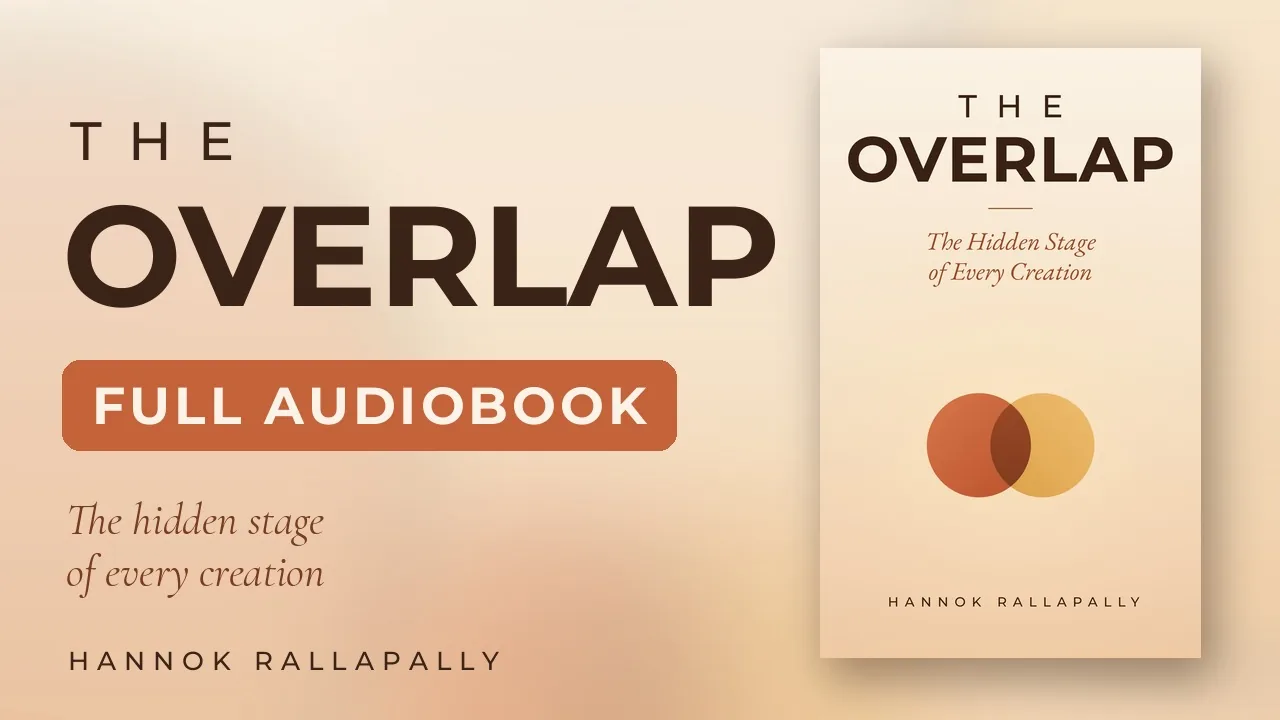
The audiobook is narrated with an AI-generated (synthetic) voice. The text is the author’s own book.
Coming soon
Very few people cross well alone. The book says you need at least one person who can see the self you are becoming, and one who will tell you the truth about the numbers. So I’m planning the first Overlap Club:
It’s not open yet, and details like dates and format aren’t set. Joining the waitlist just means you’ll hear first when it opens. It’s a place to practice, not a promise of results.
About the author
Hannok Rallapally is a technology and data leader whose work spans enterprise architecture, data governance, AI and product strategy. After more than fifteen years working across complex enterprise environments, he and his family have also run a small bakery. He is based in Texas.
The Overlap was written from inside his own transition rather than after it. His writing focuses on how people and organizations can build the future without denying the responsibilities, uncertainty and human consequences of the present.
Get the book
Paperback and Kindle. The links appear here the day the book goes live.
Paperback: 166 pages, 6 × 9 in · ISBN 979-8-16-090456-6
One email when the book is live, and the occasional note from the middle. No spam, unsubscribe any time.